Because it does not force anything. A drug works by pushing one pathway up or down, and that push travels into every process coupled to it – that coupling is what side effects are. coMra adds no chemistry and manipulates no single receptor, enzyme or pathway; it improves the conditions the cell works in – energy, transport, regulatory signalling – and leaves the cell's own regulation intact, so a cell that does not need more ATP does not make more. Each radiance also runs at low intensity inside a broad safe window, which is why there is no overdose risk even with extended use; the User Guide precautions still apply, including keeping the device at least 30 cm from a pacemaker.
In a sequence, not all at once, and knowing the sequence is how you read your own progress. Within minutes to the first sessions: pain eases and wellbeing lifts, as cellular energy and membrane transport are restored. Within days: tissue-specific function resumes – sleep, digestion, muscle work, immune activity. Over weeks the neuro-immuno-endocrine system shifts out of stress and depletion towards the calm activation in which repair runs well; structural regeneration comes last, over weeks to months, and where damage is serious and long-standing, months to years.
No. coMra is painless and non-thermal – no heating effect is produced, so there is often little to feel while the treatment head is in place, and that says nothing about whether the therapy is working. The biophysical effects in tissue do not depend on sensation, and they are not disease-dependent: the same energy boost, the same transport enhancement and the same coherent message occur whether or not you notice them. Many people do notice something afterwards – a sensation of lightness in the body and a lift in mood is among the most common reports after treating acute pain, which fits a cellular energy balance that has crossed back above baseline.
Three things at once, in the tissue under the treatment head. The infrared laser and the magnetic field open an additional ATP synthesis channel – the field holds the photoexcited state long enough for the reaction to complete, raising ATP synthesis efficiency by 200–300% – so the cell has more energy available. The ultrasound creates gentle vibration that speeds molecular transport, bringing substrates to enzymes and carrying products away; in vitro, adding 40 kHz ultrasound raised enzymatic clot breakdown from 37% to 93% without mechanically disturbing the clot. Meanwhile the colour sequence delivers the regenerative or rejuvenative message, and in injured tissue energy balance can be restored within minutes.
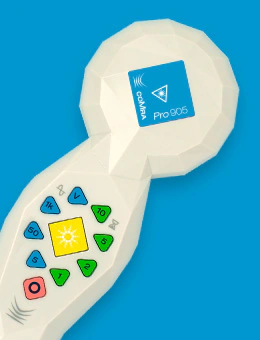
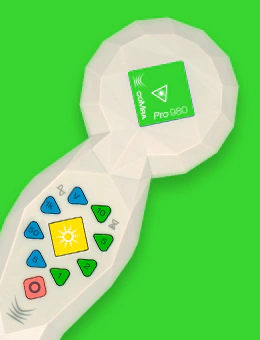
Because the order is the message. Healing runs through phases – cleanup, then active growth, then remodelling – and each phase needs a different signal, so coMra sends its three colours (red 650 nm, indigo-violet 420 nm, yellow-green 570 nm) as a sequence rather than as one instruction. Red → indigo-violet → yellow-green is the regeneration sequence, used where tissue is damaged; red → yellow-green → indigo-violet is the rejuvenation sequence, for enhancing healthy tissue and recovering after exertion. On the coMra Pro you choose between them with the Function button: the default Healing function runs the regeneration sequence, and the Vitality function the rejuvenation sequence. That order carries meaning is demonstrable: illuminating cells with blue and then red nearly doubled DNA synthesis, while the reverse order produced no effect at all (Karu, 1985).
Deep enough to work on internal organs. The laser operates in the optical window between roughly 600 nm and 1100 nm, where blood and water absorb light least; 905 nm reaches deeper than 980 nm because water absorbs about six times less at that wavelength. Effective depth is then set by the modulation frequency: 5 Hz for 5–10 cm (internal organs), 50 Hz for 1–2 cm, 1000 Hz at the skin surface. Effective depth is not the same thing as how far a single photon travels – it is the depth at which the coherent beam produces its optimal effect.
No – the effect comes from the relationship between the four radiances, not from the intensity of any one of them. The emitters are matched to each other, and raising the output of one above the others diminishes the effects of the rest and cancels the synergy that is being sought. Single-modality therapies have to be dosed carefully because of the biphasic response: below a threshold nothing happens, above an upper limit stimulation turns into inhibition. coMra sidesteps that by keeping every radiance low and letting the combination do the work – which is also why treating longer or "harder" than the protocol adds nothing.
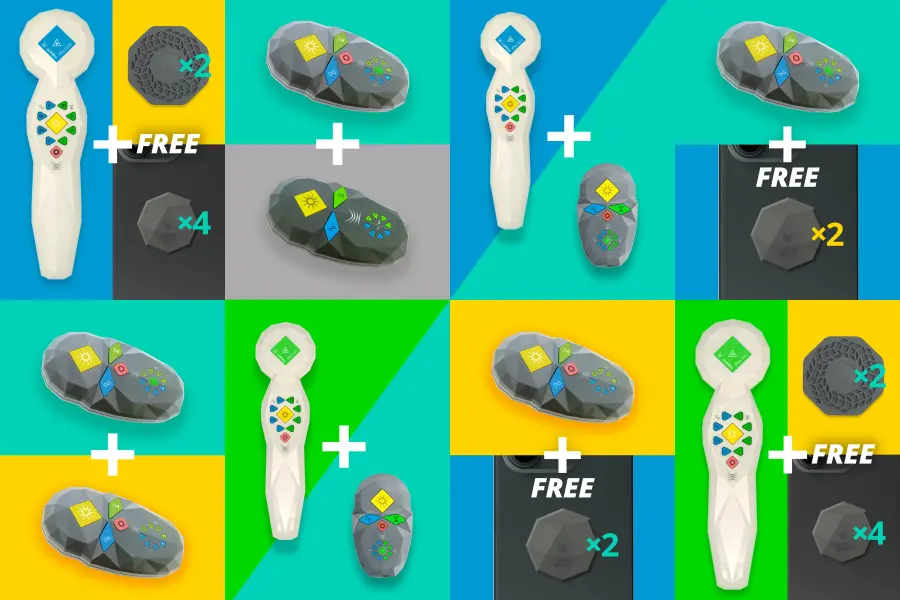
An ordinary low-level laser or LED device delivers one form of light; coMra delivers four radiances into the same volume of tissue at the same moment – infrared laser, a permanent magnetic field, low-frequency ultrasound, and a sequence of coloured LEDs. The combination is not additive: applied on its own, a single radiance does not produce even a quarter of the coMra effect. Measured directly, infrared laser plus red LED plus magnetic field changed the activity of the mitochondria – the cell's power plants – by 22%, while the same modalities applied separately produced no detectable change at all – and light alone had to be raised tenfold to approach that result. coMra is a coherent combination, not a stronger laser.
Because it works upstream of any single disease mechanism: coMra raises the cell's capacity to self-repair and leaves the decision about what to repair to the body. The biophysical effects in tissue – more available energy, faster molecular transport, a coherent regulatory message – are the same in every tissue and in every condition. What differs is what your body does with them, and that response is specific to your state, your age and your situation. This is why one device applies across a very wide range of conditions without disease-specific tuning.
Functional reserve is how much a cell, organ or body can step up its function when more is asked of it – the distance between everyday output and maximum output under load. It has four aspects: energy, structure, regulation, and the person's own psychological engagement in getting well. When the reserve is spent, the cell keeps running but suspends its own repair first, and structure begins to deteriorate – this is what disease looks like from the inside. coMra works on the reserve itself rather than on symptoms, because restoring it is what gives the body room to repair.