FEATURED ARTICLE

The Problem of Pain

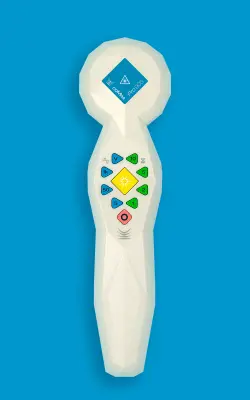
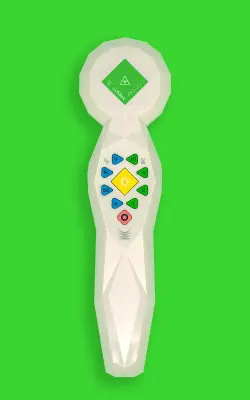
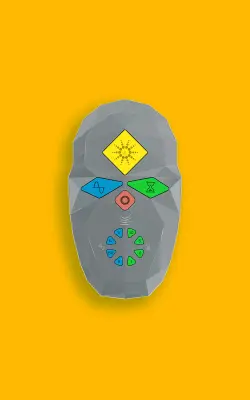
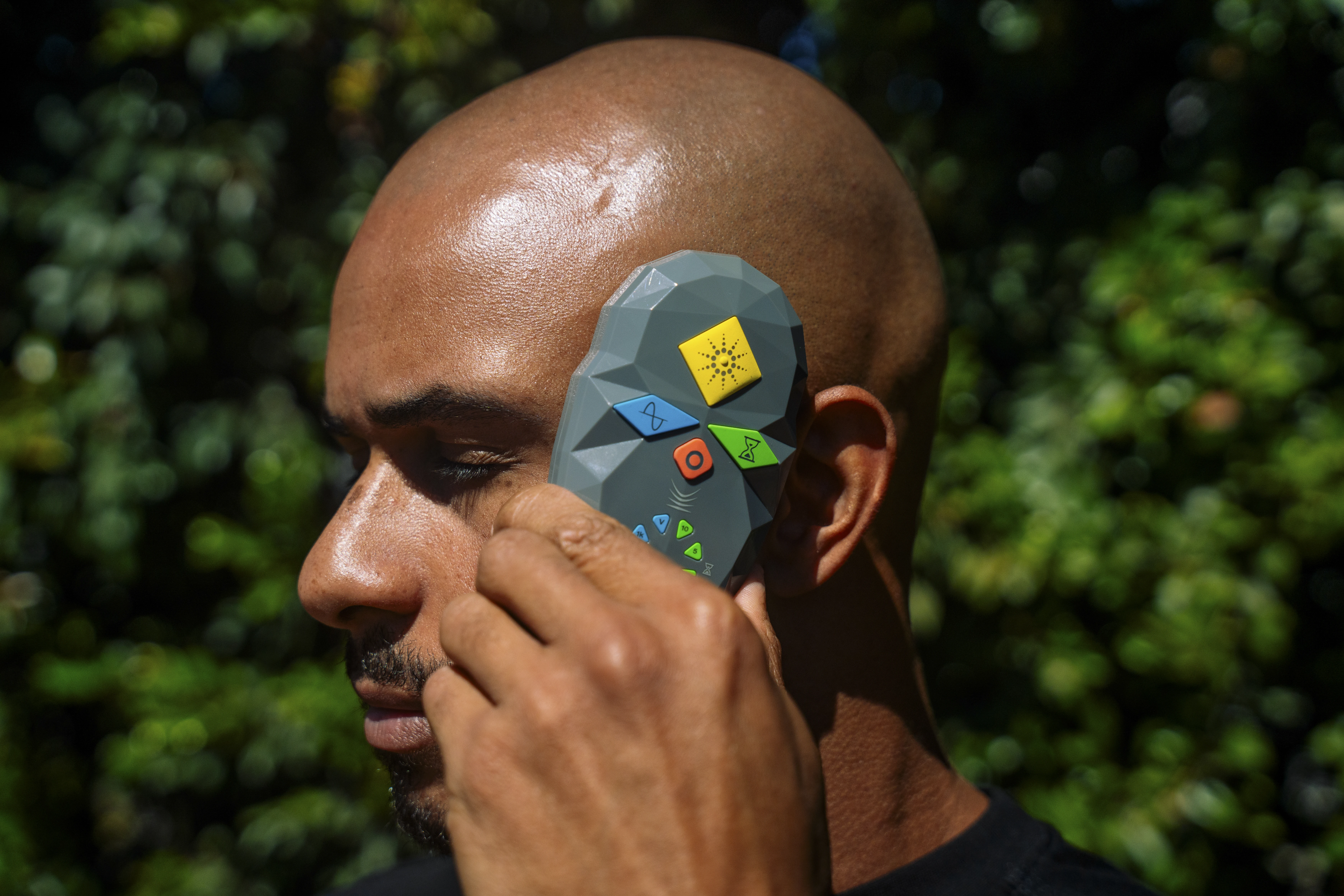
Chronic pain affects over 1.5 billion people globally, with traditional medications often causing significant side effects. coMra therapy presents a safer alternative by combining laser therapy with magnetism, ultrasound, and…

Read this article
The Problem of Pain
Browse our blog and see all articles

Customer services

Our customer services team are seasoned practitioners of coMra therapy with over a decade of experience.

If you're considering a coMra device – but have questions not covered in our extensive Resources and FAQ pages – please send us an email and we'll get back to you soonest:

info@comra-therapy.com

User support

If you already own a coMra device and need help with your device, with your treatments – or with any technical issues – please reach out to us here.

Click through on the link below, send us an email and we'll get back to you:

support@comra-therapy.com

Schedule a call

If you'd rather speak with one of our experienced customer service team members, you can schedule a call with us instead.

Please click through on the Calendly link below and one of our customer service team will get back to you:

calendly.com/comra-support-team

Chat with us

Alternatively, our customer service team are on hand to answer your queries between 9:00–5:00 EST.

Please click through on the link below, or simply click the floating Chat icon on the bottom right of the screen.

Chat with customer services now!
WARRANTY

Register your coMra device!

If you recently purchased one of our coMra devices, welcome to the family! Please fill out the registration form below to activate your warranty.

How do I find my serial number? Found on the sticker on the back of your original product box.

Post Menopausal Osteoporosis

Download PDF
English

Introduction

Osteoporosis is decreased density of the bones caused by an imbalance in bone modeling in which resorption takes over the formation.

It is a wide spread disease with Post Menopausal Osteoporosis being the most common type.

Medical science considers the cause of osteoporosis unknown.

Medications for osteoporosis try to alter the bone modeling process, but they have many side effects.

Case Description

Female, 63 y.o., had pain in the lower spine, right hip, right knee, and general muscle weakness and deterioration in both legs. Hew diagnosis was:

  • Scoliosis in lower spine for over 50 years; resulting in tilted hips and uneven leg lengths with majority of weight on right leg. Over time right knee splayed laterally outward to compensate for uneven leg lengths.
  • In her early 50's diagnosed with osteopenia.
  • Arthritic pain in her lower spine, both hips and right knee started at age of 56.
  • In 2007 she underwent total replacement of her left hip due to continuous pain and immobility.
  • Diagnosed with Osteoporosis in 2011 via Bone Density Scan.

She has been prescribed biophosphonates to treat the osteoporosis, but she refused taking them.

Treatment

The patient treated herself at home with her own coMra Delta, performing the following treatments from the User Guide:

  • Traumatology 1 for Osteoporosis;
  • Traumatology 9 for her right hip;
  • Traumatology 10 for her right knee.

The patient begin using coMra November 2010, for osteoarthritic pain and the weakness coupled with decreasing mobility. She has been doing 1-3 treatments per week.

After she was diagnosed with osetoporosis in March 2011, she started doing all of the above treatments 2-4 times per week.

coMra Pro 980 Medical was used.

Results

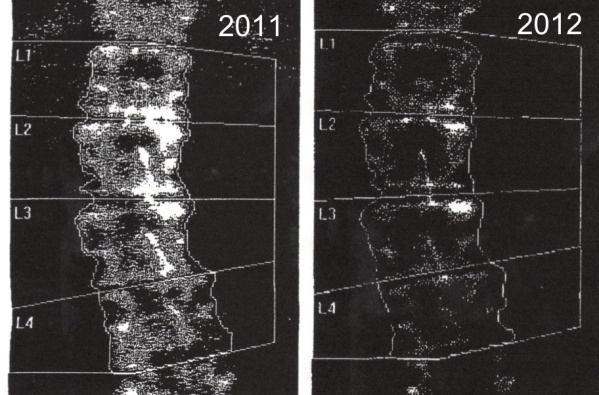
The DXA scans performed in March 2011 and again in February 2012 indicate significant improvement in patient's condition over the 11 month period.

Hip Scan

Quantitatively, there is 4.7% increase of the total mass density of her right hip against of expected deterioration/decrease (estimated by the average of the observations of the patients with similar conditions) of 1.5%.

Lumbar Scan

There has been a statistically significant increase in bone mass density of 3.6% in lumber region over an 11 month period. Again the average development is such cases is 1.5% decrease.

The patient reported increased mobility and decreased pain.

Case provided by: Garrett Murrin
Country: Canada