



 coMra user guides


 Articles
 Testimonials
 Case studies
 Podcasts




 Customer services
 User support
 Schedule a call
 Chat with us

 My last searches
 Popular searches
I was in doubt on how to write about its subject, which is dealing with the root causes, because my experience with this topic is small compared to that with the previous topics.
What does it mean to deal with the root causes of a disease?
In Health & Holism in 21-st Century book there is a chapter - Chapter 5 - which tabulates the true psychosomatic causes of a number of diseases. For example,
Gland disorders: Severe emotional and mental stress.
Working with these causes means for me that, first, I need to recognise them (in this example that I have stress; what causes it; and how can I mitigate it, etc.) and then balance the dis-balance. Recognising is sometimes easy - as it is obvious - sometimes not; and the same applies for the re-balancing. The benefits of this process are twofold: first, the symptoms subdue and, second, I learn something about myself.
In the case of Hashimoto it has been stressed by many different authorities that stress management is very important. But - of course - Hashimoto does not reduce to gland disorder. So, what is its real cause? Unfortunately, it is not listed in the book.
This, however, does not stop one from working with what is available in the sense of regaining the balance.
From what I have read from various sources on Internet I have picked some concepts that I like and that suit me and worked with them.
Some say that Hashimoto is a chance to pay more attention to oneself. For example, I often do strolls in the park and I do not feel guilty that I am not doing something else. If I were healthy, I would have thought that it is better to use my time for some project instead. Of course, this concept of giving oneself extra care applies to all diseases. It is only regrettable that for most people it must first come to chronic disease, but "c'est la folie".
Another idea is that people with Hashimoto must learn to stand for their rights. Like for example learning to say 'no'. I very much like this idea as 'No more Mr Nice Guy!' me. I would only add that this should be done with ruthlessness and NOT with a chip on one's shoulder.
The third idea that appeals to me is that people with Hashimoto have higher than the average need to learn to communicate. The communication is an art that has to be studied. I will give you few further references which are useful not only for the art of communication, but also for the art of relationships in general. And, as we all know, messed up relationship do not do wonders to health disorders.
So, I strongly recommend to you the short (and almost free: only the Amazon charge) book The Journey of Adjustment. It is written by the founder of coMra Therapy Théun Mares (who is also author of Health & Holism in 21-st Century) during another stage of his work.
Just one quote on communication:
However, not being able to communicate effectively means that one cannot relate properly to the world, or to others. But most important of all, it means that you will also not be able to relate to yourself, for if you cannot express even to yourself what will make you happy, then how can you ever hope to be happy?
Mares, Théun. The Journey of Adjustment: The Toltec Teachings – Volume 3, Part 1 (The Toltec Teachings - Volume 3, Part 1) (Kindle Locations 1192-1194). Renascent Legacy Press. Kindle Edition.
The material of this book is extensively studied and practiced by Elizabeth Schnugh, who has given numerous courses courses on it. I have attended few of them and they are most excellent. Recently she put out a series of videos on YouTube that you may follow at your leisure. Here is one of the shortest:
I hope you will find these resources useful!
Thank you for following up to this point and I wish you all the best on your journey of healing!
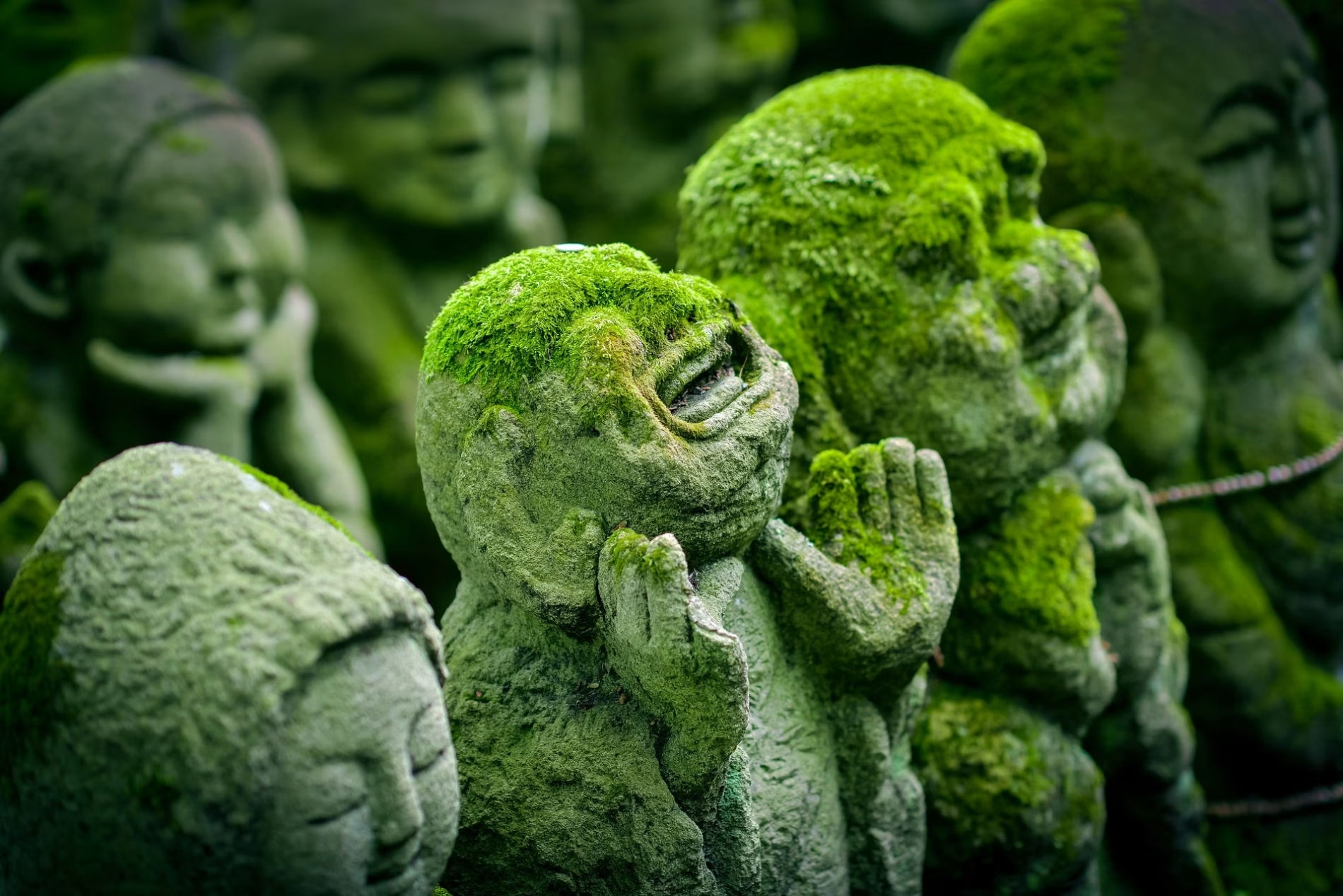
*Image by Jordy Meow from Pixabay