


 coMra user guides


 Articles
 Testimonials
 Case studies
 Podcasts





 Customer services
 User support
 Schedule a call
 Chat with us

 My last searches
 Popular searches
Please refer to the webinar recording to learn more about the general principles of coMra therapy and view examples of real life cases.
Having seen how other people have used coMra therapy to treat their nerve damage, you may have questions like: “But what about my particular situation? Can coMra help in my condition?”
Although such questions are natural, we need to keep in mind that coMra therapy has a fundamentally different approach to, say, pharmacological interventions or surgery. coMra therapy is a medical technology that enhances the ongoing self-repair of cells in a living organism. This means that if any part of your body is in pain, shows signs of impaired function or damage then you can use coMra to support your body in its job of repairing the injured cells and restoring their function.
So the answer to the majority of these questions is “Yes, coMra can help you, because it can be used to treat almost any condition where the body is struggling to restore health or recover from a disease or injury, including nerve damage”.
In this Support Paradigm we let the body itself do the work of healing the injury. With coMra therapy we can make this process simply much more efficient.. As a result, acute injuries can be healed on average 2-3 times faster, while chronic conditions can gradually be stabilised and even reversed.
Keep in mind that the body's self-repair is not limited to healing an injury. It is an ongoing maintenance process that offsets accumulation of daily wear and tear in every cell and organ. Therefore, you can also use coMra to increase the functional resilience of your body as a preventative measure, without waiting until you have a full-blown disease or in order to compensate for aging, a sedentary life-style, daily work stress, etc.
So to answer specific questions submitted to us for the webinar, let us rephrase them in the Support Paradigm of coMra technology and answer the following:
-
Which organs need support in my situation?
-
What results can I expect?
-
Which coMra device is best for my condition?
-
How should I apply the coMra device?
We answer the questions as best we can given the amount of detail provided. If certain information about a specific case is missing then we make some assumptions in order to offer an overall direction and possibilities on how coMra can be used.
Please read all Questions and Answers, as we present useful information about coMra therapy that is applicable across the entire field of nerve damage and neurology in general.
A special note to existing home users of coMra devices
To unlock the full potential of having a coMra device at home we encourage you to learn how to trust yourself and your body.
Obviously, when the situation is dire, we must seek qualified medical attention as soon as possible. But once the emergency is over, it is our responsibility to support the body in its self-repair and your coMra device is a versatile tool to do just that.
So start using your coMra device for any ache, pain, bruise or disease in yourself or your loved ones. Given that you’ve read and understood the “Before You Start” section in the User Guide, it is a fundamentally safe technology designed to be used by a lay person without any medical education.
We all have an inborn ability to sense if there is any discomfort or disorder in our body. Let this sense guide you and apply your coMra device without fear or worry. The coMra User Guide gives plenty of examples of how to approach the treatment of practically all organs, systems and common situations. If you feel better after a few treatments or a full course then you have correctly identified which organs and systems needed support. In the worst case, you will be applying your coMra device to a completely healthy organ, making it even more robust and resilient!
Sometimes it is not clear why we feel sick or unwell. Seek advice from your doctor to establish a diagnosis and do your own research to understand which organs and systems are involved in your condition in the most generic terms. Once you have a reasonable understanding, go through coMra User Guide and apply the protocol that is closest to your diagnosis. Please ask for more support at support@comra-therapy.com if needed.
As we continuously increase our bank of knowledge of healing and coMra, please send us your feedback and regular updates on your condition. This way we all can learn from each other about the best practices and results.
Section 1. Peripheral nerve damage
Pain after resuscitation with a defibrillator
“I had my first heart attack six years ago, whilst having an angiogram done. My heart stopped. Doctors used AED to resuscitate me (on my chest and just beneath my breast).
Two days later I had a terrible case of shingles where AED was applied, and since then I keep having these shooting burn pains at the same spot where the shingles were.”
Answer
Which organs need support?
From what you have described, it is very probable that the pain you are experiencing is a result of nerve damage from a combination of factors. The electrical shock delivered by the AED could have damaged the nerves around the rib cage. Dormant virus in the nerves would rapidly spread along the nerve pathways causing skin rash and burning pain, a condition known as postherpetic neuralgia.
What results can I expect?
Since the pain has persisted for many years, the nerves are still alive but the self-repair process was insufficient to heal the initial injury and the pain became chronic.
Therefore, coMra therapy certainly can help you in your condition and possibly reverse the combined damage by the electrical shock and viral infection. We have had a number of reports from coMra users and coMra practitioners experiencing good results with postherpetic neuralgia.
Individual recovery progress varies strongly from person to person. If postherpetic neuralgia is relatively recent, then only a few weeks of daily treatment could be enough for a full recovery, as shown in the webinar case on postherpetic neuralgia.
But given the chronic nature of your condition (six years), recovery may take from a few weeks to several months of everyday treatments for initial improvement and further repeat courses in the case of severe damage to the nerve structures.
Which coMra device is best for me?
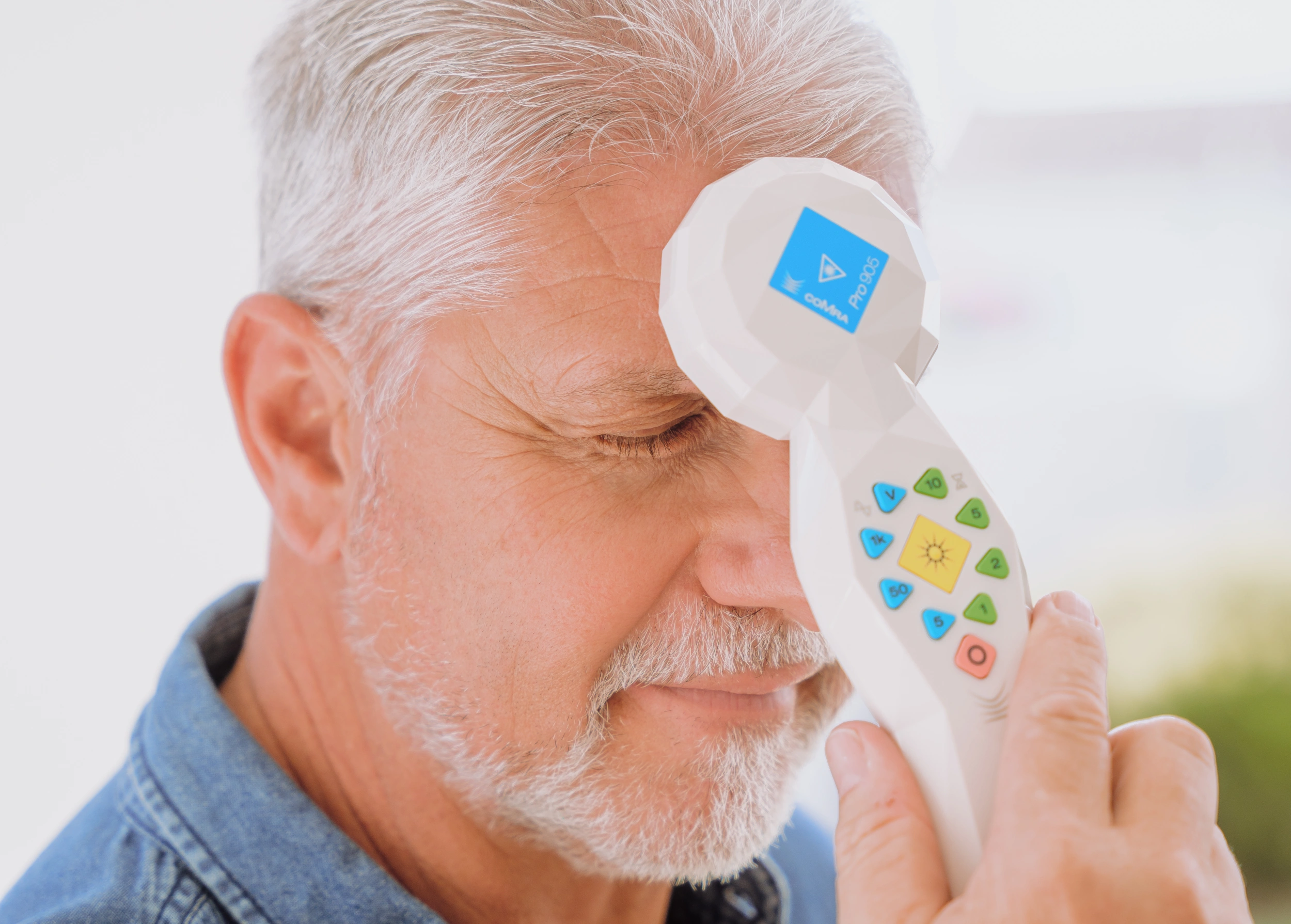
In most cases of moderate to severe structural nerve damage or when the condition is chronic, we recommend the coMra Pro device with 905 laser for a deeper and more intense effect to assist the nerve repair.
However, if the pain is very high then the coMra Palm device or coMra Pro device with 980 nm laser could be a better place to start for the first 2-4 weeks. The 980 nm laser in coMra devices has a more gentle and gradual action. Once the pain becomes bearable, at least temporarily, then consider switching to the 905 nm laser device for a deeper and more long-lasting effect on structural repair.
How should I apply coMra?
Neurology 16 protocol in the coMra User Guide gives an example how to treat postherpetic neuralgia:
-
Apply the coMra device directly to the area where you experience pain (scan just above skin surface),
-
Treat the nerve roots to the left/right of the spine at the chest level (between shoulder blades and lower)
-
If the pain is very strong, do the protocol up to 2-3 times per day
Also, we recommend the Universal 3 protocol (Blood) once per day to support nerve recovery and your immune system to prevent future virus outbreaks in the nerves.
Once the neuropathic pain starts to subside, you may also consider doing 2-4 courses per year of the Cardiology 2 protocol to ensure long term recovery of the heart and heal any possible remaining damage after the heart attack.
Severe pain in the legs after surgery to unblock femoral arteries
“Three months ago I underwent major surgery to unblock the femoral arteries in my legs. Although my recovery is going well, I am suffering from severe pains in my legs mostly at night which nothing seems to relieve.
I have mentioned this to my surgeon on several occasions but he cannot give me a clear answer other than to say, it could be the nerve endings healing. This pain is like a stabbing pain (usually in my knees) and can last from a few minutes to 10-15 minutes several times during the night which keeps me awake.”
Answer
Which organs need support?
You already know the immediate cause - impaired blood circulation in the legs. Even if the surgery went well, still the traumatised tissues need time and support to recover, especially after a major surgery.
Also, since your surgeon suggested that the severe pain is due to nerve damage, we need to consider the possibility that nerves were starved of oxygen and nutrients and their normal self-repair was seriously impaired by the lack of blood supply.
Therefore, it makes sense to use coMra therapy to support and enhance blood circulation in the legs, while at the same time treating the affected nerves. As vessels and nerves start to recover, the pain will become less and less.
What results can I expect?
coMra therapy is most excellent for post-surgical recovery in alleviating pain, reducing inflammation, preventing scar formation and speeding up restoration of healthy function. Typically first results are noticeable within minutes to hours of treatments. Pain medication often becomes unnecessary.
If there was no prior history of atherosclerosis or other systemic chronic diseases, then recovery with coMra therapy could take from a few weeks to 1-2 months depending on the extent of surgery. But if you have had the condition for a longer time, it is advisable to continue with coMra therapy long after the initial pain relief to ensure complete recovery.
Which coMra device is best for me?
Since you currently have severe pain, we recommend starting slow with the coMra Palm or coMra Pro with 980 nm laser. And if your condition is relatively recent, one of these devices should be sufficient for a full recovery.
How should I apply coMra?
Surgery 6 protocol in coMra User Guide gives an overview how to approach impaired blood circulation in a leg. Note that the same treatment points are suitable to treat the major nerve branches of the leg (femoral and sciatic nerves). Therefore, you will treat both the major nerve and blood supply to the leg at the same time.
In addition, we recommend scanning at 50 Hz the area where you had the surgery, the area where you experience pain and the calf muscle to support the outflow of venous blood. By scanning these areas you will support the smaller nerves and blood capillaries.
Small Capillary/Fiber Neuropathy
“I have coMra Palm device. Please provide the specific protocol which should be used for small capillary/fiber neuropathy. There is a lack of information/remedy on this and most information available deals with diabetic neuropathy.”
Answer
To use coMra therapy to treat any type of peripheral neuropathy, you always start with the basics:
-
treat the area where you are experiencing the symptoms (pain, burning, etc)
-
treat the nerve pathway back to its roots in the spine
For example, if you experience neuropathic symptoms in the legs, use the Neurology 15 protocol for the legs. By scanning the affected area with your coMra Palm you will support both capillaries and the small nerve fibers at the same time.
Note that this same protocol is recommended for any cause of nerve damage in the hand or leg be it:
-
impaired blood supply or
-
diabetes or
-
alcohol toxicity or
-
immune disorder or
-
infection or
-
nutritional deficiency or
-
without any apparent cause (idiopathic).
Next, if you know that your neuropathy was caused by a systemic condition, then you can combine Neurology 15 with other protocols:
-
If you have impaired blood supply, also treat the major arteries and veins in the limb (see Surgery 6);
-
If you have diabetes, do also Endocrinology 1 protocol;
-
And so on.
Tender soles
“Is burning tender soles of the feet a possible target for coMra? My doctor calls it neuropathy and I must live with it.”
Answer
Yes, coMra therapy can help you to treat the nerves and restore normal healthy sensation in the soles of your feet.
Simply scan the soles of your feet with a coMra device as well as treat the nerve roots in the lower back. See the Neurology 15 protocol in coMra User Guide.
However, it is always a good idea to establish what caused the nerve damage in the first place. If the cause remains unaddressed, it may slow down the recovery process or the improvements after a course of coMra therapy may not be permanent.
Vagotomy
“40 years ago I had a hiatus hernia repair and at the same time the surgeon did a vagotomy - cauterised the vagus nerve in my stomach. Over the years I have developed digestive problems which cause my heart to race and feelings of anxiety/panic. Is there anything that can be done to either bring back the working of the vagus nerve or help with digestion using my coMra Palm?”
Answer
Firstly, please read “A special note to existing home users of coMra devices”.
To answer the question whether it is possible to rebuild a certain nerve branch that was physically destroyed/removed, the answer is no. coMra therapy devices cannot recreate a completely missing nerve branch or an organ.
Having said that, our body is most remarkable in its ability to adapt and compensate for irreversible changes via alternate routes. However, such compensation often creates additional load on those supporting organs and pathways causing their premature deterioration and dysfunction.
Use your coMra device to support those organs whenever you feel discomfort, pain or any other symptom.
Which organs need support?
You already established the organs that you feel need support:
-
Stomach
-
Vagus nerve
-
Heart
To this list we would add:
-
Roots of the peripheral nerves (left and right of the spine, midback)
-
Solar plexus
With these organs in mind and your coMra Palm device in hand you are well equipped to start improving your quality of life.
What results can I expect?
It is very common to experience improved digestion, better quality of sleep and a sense of well-being within the first days of using coMra therapy. However, since your condition has been developing for many decades, expect your condition to relapse from time to time as your body will accumulate and expend resources. But if you persist with treatments, then your condition will continue to gradually improve.
With any chronic, very long-term condition the key is to shift the focus from grand expectations to everyday support and lifestyle adjustments with coMra: apply your coMra Palm device as frequently as necessary - up to 3-4 times per day. Keep it close to you whenever you go away from home or travelling.
Which coMra device is best for me?
When the condition is mostly a dysfunction and without major structural deficits, then the coMra Palm device is sufficient to help the organs to recover and restore their healthy function.
When the condition is serious or severe, typically it means that organs have deteriorated at the level of cell structure and more intense action with the coMra Pro 905 laser is called for.
Since you already have your coMra device, it makes sense to start treatments with your coMra Palm device for the next 3-6 months and see if the level of support will be sufficient. Otherwise consider using the coMra Pro 905.
How should I apply coMra?
If your digestive problems are limited to the stomach follow the Gastroenterology 4 protocol in the coMra User Guide. Otherwise use Gastroenterology 6 or 7 or 9 depending on the severity of the symptoms.
To address emotional stress and related organs (heart, vagus nerve, solar plexus) consider choosing between Systemic 1, 2 or 3 in the coMra Harmony User Guide, depending on the severity of the symptoms.
Section 2. Nerve damage in the head, face, neck
Inner ear
“I am struggling with recurrent episodes of vertigo and vomiting due to possible nerve damage in my right ear.
I would like to invest in the coMra Palm device, but not sure which one as you have new ones as well. If this could reduce my flare ups and recurrent episodes of vertigo that would be great! Could you please advise?”
Answer
Yes, the coMra Palm with 980 nm laser can help you recover from the condition. However, you may need to consider doing several repeat courses using coMra Pro with 905 nm laser if the inflammation is chronic and has caused significant deterioration of the inner ear and nerve.
Follow the Otorhinolaryngology 6 protocol from coMra User Guide. We are not implying that you have Meniere's disease as the protocol shows in the list of conditions. Each protocol simply shows an approach to treatment of a certain organ or a system that shows signs or symptoms of a disorder. So you can use this protocol for any condition that involves the inner ear.
In absence of a Probe terminal (requires Delta device) use coMra Palm for point 4. Note that you may increase the time per point and number of sessions per day to achieve improvement, especially during an episode of vertigo.
Also consider doing the Neurology 1 protocol to support blood circulation in the brain and all related structures, especially if your condition is chronic.
Loss of smell, taste, hearing after traumatic brain injury
“My boyfriend was brutally attacked and left for dead 4 years ago. As a result he has a brain stent, can no longer smell or taste and is deaf in his left ear with a constant ringing.
I have coMra Delta device but no Probe terminal to insert in the nose or ear.
Is it possibly nerve damage that the coMra can assist with? If yes, is it possible to get hearing and taste and smell back?”
Answer
Firstly, please read “A special note to existing home users of coMra devices”.
Since any significant head injury may cause life-long consequences, we most certainly recommend using your coMra device to support the brain, nerves and maintain sensory and cognitive functions, memory and so on, even if the symptoms are mild or “hidden”. Needless to say, in case of severe injury, surgery on the brain and loss of sensory functions, use of your coMra device is a must.
If a major brain injury occurred years ago, the first priority is to protect the brain and prevent further deterioration. Make coMra a part of your daily routine just like brushing teeth is a part of oral hygiene. Rather than a few weeks of coMra for post-surgical recovery, you are looking at months and perhaps years of consistent treatments to allow the brain to repair itself as much as possible and to “rewire” if some parts remain dysfunctional. It does not mean that you will have to wait for years to see any improvements, because we do have reports from coMra users who had meaningful and most welcomed changes even within the first weeks of treatments.
Use the Neurology 1 protocol from the coMra User Guide as a basis of your approach to treatment. Gradually add more points around the brain (1 min at 50Hz) but in case of any increased sensitivity or discomfort temporarily skip those points, especially at the location of the stent.
To support restoration of sensory functions, also use your coMra Delta device to treat the inner ear, nose and mouth even if you do not have Probe terminal. Simply place the device directly on skin or on the opened mouth.
Optic nerve damage
“I have coMra Palm device and use it daily for my own aches and pains. I would like to know if coMra therapy would also help my son’s sight. His optical nerve was severely damaged when he had a stroke at seven months (the ophthalmologist explained that it is like someone taking the nerve and smashing it with a hammer – nice!) and he is blind in that eye. All he can make out is light and dark. Is there any hope for my son’s sight?”
And from another person
“My son also has nerve damage of his optical nerve, causing him complete blindness in the left eye. How often should he do coMra therapy and at what frequency?
And from another person
“I used coMra Delta on a patient who had an optic tumor removed and when he came to me his visual field was the size of a pinpoint. In 6 months using Neurology 14 protocol his visual field increased to the size of a baseball. But he stopped further treatments because his progress was so slow. Can you send these cases to us because patients get so discouraged because it takes so long.”
Answer
This is one of the most remarkable results that coMra therapy has demonstrated - its ability to help the body in restoring optic nerve function. The recovery process, however, is not a “switch” from a complete lack of visual function to 100% overnight, but rather a series of incremental changes. Watch the case report from Dr Clark about her patient Bronwyn and presented by Garrett:
It is hard to predict the extent and speed of recovery in each individual case. The key factors are: severity of nerve damage, how much time passed since the trauma/surgery, remaining nerve function if any and the potential for recovery. In practical terms it could be very difficult to accurately assess these factors, so we recommend starting regular coMra therapy sessions (at least 1-2 times per week) for at least 3-6 months and note any changes in vision. The response to coMra therapy or lack thereof is a good diagnostic tool to assess the recovery potential. The presence of any improvements would indicate that the nerve is alive and needs further support. To restore vision as much as possible continue regular coMra treatments - courses of daily treatments with breaks in between.
In the context of a medical practice this means planning ahead. Initial in-office coMra treatments could be necessary to establish that the nerve is alive and has potential for recovery but continuing regular treatments over months and years is possible only when the patient learns the method and is willing to continue at home.
To treat any disorder of the eye and/or optic nerves, apply the Neurology 14 protocol from the coMra User Guide. In our experience the coMra Pro with 905 nm laser or coMra Delta with 905 nm laser provide the best results.
However, if you are treating a child who is less than 3-4 years old, do not treat the eye directly since he or she may not keep the eyelids closed (Neurology 14 Point 1). Rather treat the optic nerves for 2 min per side of the head (Neurology 14 Point 2) while keeping the child's eyes closed and protected from the infrared laser with your own hand. To provide an overall support for the nervous system follow the Pediatrics 2 protocol for 1 week, then break for 2 weeks and then repeat the course. Note that children are much more responsive to coMra therapy and coMra devices with 980 nm laser are recommended.
Section 3. Systemic conditions and nerve damage
Diabetes and neuropathy
“I am a professional Homeopath and I have a case of a 70 yr old man who has type 2 diabetes. He has neuropathy in his feet and lower extremities.
As a homeopath, I would look for the cause and treat that first because if it is NOT treated, it will remain an obstacle to full cure. So in this case, one would think that the pancreas will need treating - and with advice for more exercise - the circulation to the feet will increase, therefore the neuropathy would get better, over time. Obviously this is not a "quick-fix".
So my question is: for treatment of neuropathy is it better to start with the root cause - and not go directly to the site of the neuropathy? Or would you also look at the various hormones or rather the pituitary gland for any dysregulation of the neuropathic highways?”
Answer
coMra therapy fully upholds a holistic view of health and healing and offers new possibilities for both local and systemic approaches to treatment.
When we treat a person with multiple related conditions we have to look at the whole picture. What are the fundamental imbalances and what are the downstream effects? We also have to consider the immediate priorities of the person, for whom relief from certain symptoms could be a priority before he or she will be able to address the root causes.
With coMra therapy you and your patient have flexibility to address both the root cause and all downstream effects at the same time or prioritise them in any order you feel is the best. For example, if neuropathic symptoms in the feet are the only complication, you can combine treatment for the lower extremities with treatment for the pancreas in one coMra session (see the Neurology 15 and Endocrinology 1 protocols in coMra User Guide). In this way you can support regeneration of the pancreas and thus stabilize blood sugar while helping restoration of the nerves and providing relief from the neuropathic symptoms at the same time. On top of that, if the patient also has diabetic retinopathy then add treatments for the eyes (Neurology 14). If there are other complications with the heart, kidneys, joints, etc, then you can make a custom protocol where on different days of the week different organs will be treated.
Also consider combining homeopathy with coMra therapy as both methods complement each other very well and your range of services for various conditions can expand.
Regarding specific hormones and various types of dysregulations, coMra therapy does not upregulate or downregulate any specific physiological process or organ function. The action of coMra therapy is to increase efficiency of ongoing cellular regeneration in living tissue rather than selectively stimulate or inhibit certain individual processes. It is the body itself that decides on the optimal course of corrective action. In this regard coMra therapy is different from targeted action of homeopathic remedies.
Multiple sclerosis
“I have active secondary progressive multiple sclerosis causing neuropathy in my sciatic nerve on left side (which the MS has paralysed) and pudendal nerve on right. Given that I have had MS for 20-25 years, is there any point for some in my situation?”
And from another person
“Will you show an example of progressive multiple sclerosis recovery from using coMra? How long does it take to recover?”
Answer
If you wish to increase quality of life then coMra therapy is most certainly a tool that can help with multiple sclerosis. However, this does not mean that this most serious and debilitating condition will simply disappear one day. Instead, it is a gradual process of improving the health of every affected organ and function.
To understand the nature of the coMra effect, consider an analogy. If you have a headache and took a certain painkiller drug, there is no point of taking it further if the pills failed to provide the desired effect. This is the logic behind the Control Paradigm that aims to block pain signals. On the other hand, drinking a glass of water may provide relief from the headache or may not. But in any case you will not stop drinking water altogether, because water is a basic requirement for life, headache or not. In the Support Paradigm, which includes coMra, we create the best possible conditions for life to flourish and overcome challenges.
It is undeniably true that multiple sclerosis may cause irreversible changes when nerve fibers are destroyed and replaced by scar tissue. The questions we pose are: What can be done to preserve and restore the remaining living nerve fibers in that nerve? What can you do to improve your levels of energy, quality of sleep and digestion, muscle strength, function of inner organs and so on?
Please watch the story of Cheryl Terblanche who was diagnosed with multiple sclerosis 20 years before starting coMra therapy:
https://www.youtube.com/watch?v=GGRK4P2l898
Note that multiple sclerosis still remained, but by persistent, incremental improvements over months and years she was able to turn the downward spiral of degeneration into an upward movement despite many setbacks and remaining health issues. You can read about her progress of recovery here:
https://comra-therapy.com/video/relapsing-remitting-multiple-sclerosis/
Which coMra device is best for me?
We have identified that the coMra Pro with 980 nm laser or coMra Palm with 980 nm laser are the best choices to treat multiple sclerosis.